How to Take a Payday Loan Payday loans UK Why not
May 19

Realize Fundraising Is Not About The Money…

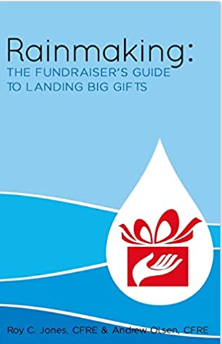
From “Rainmaking: The Fundraisers Guide to Landing Big Gifts” on page 112… 

[Save 10% by ordering here: http://t.co/ZESuoSHy92 ]

Roy C. Jones, CFRE

Roy C. Jones, CFRE

The best fundraisers know that relationships are never about money. By the same token, successful major gift officers make sure the relationships they build are never about the money. It may sound counter-intuitive, but if you want to receive large sums of money from people for your charity, your relationships should not be based on the money.

Successful fundraisers also know that investors (not just donors) write the largest checks, and that what they are first and foremost is a “friendraiser.” They make it a priority to build friendships that have absolutely nothing to do with receiving a donation.

Successful major gift officers are great at making friends with others. I remember meeting with donors and prospects for lunch and simply asking the question, “What are your plans today?” The next thing I knew I’d be taking Mrs. Smith to the grocery store or taking Mr. Johnson to the bank. I remember two or three occasions when my major gift officer duties included visiting a friend in the hospital, fixing a door hinge, re-hanging a photo and even cutting the grass (of course,with my lagging mechanical and carpentry skills, I have to be pretty careful).

I learned about this above-and-beyond mentality from a co-worker many years ago: I’d called to check on how his visit had gone with a donor, and a dear older lady answered his phone. She said that “My friend is helping me paint the front porch right now and could he call you back in an hour or so?”. Now that is a real friend.


May 6

Do Your Supporters Have a WISH LIST?

Roy C. Jones, CFRE

Roy C. Jones, CFRE

Most charities spend a lot of time telling their major donors and supporters about their “wish lists”.  The things their charity wants to do if donors would just write them a check.

However, the secret to securing more major gifts is NOT telling your supporters your wish list, but getting them to tell you theirs.  What are your donor’s dreams and desires for philanthropy.   What are the things your donor would like to do if money were no object?   What would they do for charity if suddenly they had all the money in the world?

Your relationships with your major donors should be cultivated to the point that they are not afraid to tell you their innermost dreams and secret wishes.  What things would they like to do if God gave them the resources to do it?

My friend and co-worker at www.WorldHelp.net, Cyrus Mad-Bondo is from the Central African Republic.  He knows something about dreams. He grew up on the the African continent and has worked to relieve suffering not only in the Central African Republic but has helped the poor, orphaned and suffering in Uganda, Zambia, Kenya and Rwanda.  I have been with Cyrus when he talks with our supporters.  Although, he has wishes, dreams and desires for our programs, he takes the time to ask his supporters, “What is your wish list?  What would you do if suddenly money were not a concern?”

The amazing thing is that donors rarely pause when asked this question.  If you’ll just be quite and listen, they will tell you their most intimate wishes of their heart…   Then the work begins together to start fulfilling those dreams one project at a time.

Mar 28

Get Your Charity a Ladder… Please!

Roy C. Jones, CFRE RoyJonesReports.com

Roy C. Jones, CFRE
RoyJonesReports.com

Most organizations use “ask handles” (sometimes called an “ask table”) in order to do upgrade giving through their direct mail fundraising.

 When the economy is good most charities will use the donor’s previous highest gift to calculate the three or four ask amounts in the gift array on the reply device in the letter. In short, the donors previous highest contribution (HPC) is the lowest amount you would ask for… the subsequent amounts might be: HPC; HPCx1.5; HPCx2; and Other.

 When the economy is sagging, LIKE NOW, most not-for-profits use the donor’s last gift or average gift as the base to calculate the gift array. This tends not to upgrade too quickly and in most cases upgrades giving more gradually by simply lifting average giving.

 Now for the question, “Is a gift array strategy the only tool you should use to upgrade donor participation?”

 The obvious answer is “NO”.

You must do more in this economy to identify and harvest major gifts from your donor file. I am a big proponent of identifying “asks” around your programs existing program.  Review your budget, analyze your program and look at every expense.  Then repackage your programs and projects around the natural giving clusters that form around specific amounts in order to benchmark giving.

I compare it to having “rungs on a ladder”. You need to have $5,000 asks, $10,000 asks, $25,000, $50,000 and $100,000.  With no rungs or levels between entry level giving and estate gifts it is almost impossible to take donors to the top of the giving pyramid.

Donors truly climb the ladder in their giving from one year to the next.  It is extremely rare for a new donor to pull out their check book and write you a check for $100,000.  Major donors are investors by nature.  They will give you $5,000 and then measure your stewardship and impact.  If you do well, their next gift could be $10,000 to $25,000.  If you do poorly in reporting your impact it will likely be their last gift you get.

How do you find $1 million donors?  By building a base of 6-figure donors that you are demonstrating impact from one

Roy C. Jones, CFRE

Roy C. Jones, CFRE

year to the next.  How do you get $100,000 donors by demonstrating the best return on investment for their gifts at $10,000, $25,000 and $50,000.  Donors move up the ladder from one year to the next as you ask for more and demonstrate that you have been a good steward with their previous gifts.

Mar 17

What The “Internet Gurus” Are NOT Telling You About Fundraising

onlinegivingInternet giving is going up, up and up. The real question is why, why, why?

The median online revenue growth rate in 2012 is over 13 percent; in 2011 it was 15.8 percent, compared to 20 percent growth in 2010 over 2009. The gurus that work in the Internet and social media are almost giddy when they talk about it. I have heard some of the most ridiculous and unfounded conclusions in recent weeks. “Events in the real world are a waste of time”; “Telephone calls should never happen”; “No one reads hand written notes anymore”; “Fundraising mail is a complete waste of money”; “Direct mail is dead”…

The facts are that nothing could be further from the truth.

So many Internet gurus mistakenly lead people to believe that donations happen because people wake up in the morning and magically say, “I am going to send charity X a donation on my computer”. They convince their clients to curtail other forms of fundraising to rebuild their website every 24 to 36 months. The gurus of the web tell their clients “if you build it they will come.” Make no mistake about it, web sites are important and one day within this century, we will see all other forms of communication die. The tombstone for that day will not be in 2013, and will likely not be written for another decade or more.

What is really happening today? Donors are using the website as the “transaction form” for their giving.

If you do an event today, many participants will go on line to complete the pledge they made. Would the donation have happened without the event? Of course not… If you call a donor to talk about a project, most do not give on the telephone. After you hang up, they go on line to your website and make a gift? Would the donor have just magically gone to the website to donate without the call? Nope. If you send them a fundraising letter about 25 to 30 percent of all mail donors go on line today to process their donation today. Without the mailing, would those 3 out of 10 donors have given on line? Probably not.

Make no mistake about it. Web based donations do happen. Emails are used successfully to drive people to your website to donate. Nationally the response rate for house email files (people who have given to you before) is around 1%. One out of every 100 to 150 people will respond to your email appeal. If you are prospecting for new donor that number is a fraction of one percent. 1 out of 1,000 -1,500 will respond.

What the pundits and gurus fail to understand is that it is not an “either/or” scenario. It is not direct mail versus other marketing channels. It is direct mail AND the other channels. The word you should be talking about today is INTEGRATION.

Integration is the key to increasing the number of donations your charity receives.  You must not get hung up on year over year giving from the individual communication channels.  You have to track total revenue from all combined channels.  There is just too much shifting back and forth between direct mail, white mail, telephone, internet and events.  These silos work together in 2013.  Donors go back in forth between silos based upon convenience and the time of year. 

The way people give is changing. There is no doubt that the direct response fundraising metrics are different today than even one year ago. Gone are the days when direct mail was the ONLY tool for identifying, cultivating and renewing donor giving. Today, direct mail continues to produce checks in the pre printed reply envelopes. However, direct mail is playing a far greater role in driving transactions to the charity’s website.

If you track the daily giving to your charity’s website you are going to see that online giving mirrors the dates when your direct mail pieces arrive in-home. The spikes in giving online always follow, within hours, a mailing being placed into your donor’s mailbox.

So many “Internet Gurus” are churning out blatantly false information about what is occurring in digital fundraising. Fundraising “experts” are saying that all fundraising is shifting to the internet because it’s the new technology and they are absolutely wrong. When people give on line it is no more about the technology as saying when people give in the mail it is because of the paper.

I met recently with the president of a not-for-profit who shared that “we are going to stop using the mail entirely and move to digital communications exclusively.” After falling off my chair (for the dramatic effect, of course) I shared with him that he was about ready to “deep six” his organization. He had accepted another guru’s pronouncement that “direct mail is dead” at its face value was preparing to tell his donors “use your computer or give your money to someone else.”

I encouraged our new convert to “internet only” giving to look at on line donations by day and guess what he discovered? Seventy percent of his on line donations came within 48 hours of his in home mail date.

I asked the web convert how much cash he generated from his acknowledgement letters last year. Of course, he had no idea. When we ran the report we saw that he generated nearly 50,000 thank you letters which included a postage paid BRE for return gifts. The business reply envelops brought in an additional $300,000 in cash. Guess what happens to that income without direct mail fundraising? Poof… it is gone. You just lost $300,000 from the thank you mail alone.

Next I asked the “internet only” convert to look at checks over $500 that was sent to the organization through “white mail” (in the donors own envelop)? We were both shocked when the report came back that over $1 million came into the charity in the donors own white envelop that had not been attributed do the direct mail program, but the major gift program. When we looked at the dates he received the white mail donations…. Over 85% came into the charity within 72 hours of the in home date of the direct mail piece.

Where do major donors come from? Do they just magically appear? No, major donors come from the direct response program. Mail, events and the internet must work together. It is that simple. They go hand and glove. You really can not have one without the other.

[NOTE: Do not ask me why it is so but donors writing checks for $500, $1,000, $5,000 or more often DO NOT USE the pre-printed envelops that they are given with the direct mail piece. Anytime you increase the number of zeros on a check you dramatically increase the odds that they will use their own envelop.]

Remember…. acknowledgement giving, major donor gifts, planned gifts and internet giving do not happen in a silo by themselves. You have to look at the totality of each fundraising program. These marketing channels must continue to be fueled by direct mail packages.

Do I believe that fundraising is changing? You bet I do…. The reply device is what is changing in the industry.

Donors are going to use the medium for transferring their money to the charity that is the most convenient and trustworthy at the time of the transaction. In growing number of cases that will be the group’s website or their own envelop. Pre Printed reply envelopes and BRE’s will be used less in 2011 than in 2010, but there is one thing that will stay the same. Direct mail will be the tool that drives people to give, regardless of the medium the donor decides to use to transport their donation.

Roy C. Jones, CFRE

Roy C. Jones, CFRE

Direct mail pre printed reply devices may be decreasing in use, but the direct mail fundraising letter is at an exponential high. People are reading their mail and then using the giving channel they want.  More and more donors are transacting their gift on line.  Remember, in 2013 the key will be how you use direct mail AND the internet, not direct mail or the internet.

To quote my friend Mal Warwick, “The old reports and donor pathways are no longer sufficient—you must build a way to see, track, and analyze all the different ways your donors are experiencing and interacting with your organization in order to be able to build and refine a true multichannel fundraising and cultivation strategy.”

Feb 1

What Do Major Donors Really Want?

Roy C. Jones, CFRE

Roy C. Jones, CFRE

I had the opportunity recently to meet with 3 mega donors at a conference for one of our providers of food that we send to starving children in around 20 countries.   These major donors independently offered great insight into their thinking about giving and what information they rely upon before making a gift.

First and foremost, they never referred to themselves as major donors or providers of major gifts.  Those are words that we fundraisers use to describe them, but it is not how they view themselves. Each and every time the donor referred to themselves as an “investor”.

One mega-supporter said it this way, “I don’t give money away.  I make investments.  Before providing support to anyone I measure impact, I want to see how many lives my investment will touch.  I will often compare the impact of the amount I am asked for with what kind of impact I am having somewhere else.”

This donor confirmed what we development directors fear… “that they support charities other than mine.”  Major donors are often what we call in the industry “multis” or “multi-donors”.  They invest in multiple charities and causes. Russ Reid, a fundraising agency, conducted a major study called, Heart of the Donor, that included more than 2,000 donors nationwide and found that the average donor gave to 6.3 charities.

Major donors are looking for increased Returns-On-Investment.  ROI is critical to them.  They want to see the maximum number of lives impacted for every dollar invested and, as importantly, they want to see improved ROI from one year to the next for your charity.  Rest assured of one thing, major donors have money because they know how to maximize every penny.

The other thing that surprised me was that all three major donors said that they did not begin to make significant investments until after they had volunteered at the charity.  This concept runs contrary to what I was taught about major gift development working for political candidates.  I remember in the early 1980s setting in class at the Republican Campaign Academy and hearing Lee Atwater say in his southern drawl that “volunteers volunteer and donors do one thing: write checks… don’t waste your time tryin’ to get donors to volunteer and volunteers to give money”.

There is no doubt in 2013 that volunteerism is critical to good stewardship and an important step in upgrading giving.

So whether you are trying to get volunteers to to take short term missions trips with you or getting them to feed the poor at your food bank here at home, get your major donors involved!  Create activities that they can take part in the connect them to your ministry and service.  It will ultimately impact their giving.


Jan 10

The Ask… Is it your “spot on the wall”?

Roy C. Jones, CFRE

Roy C. Jones, CFRE

The Ask… no other action, technique or step in your fundraising program is more important than the ask.  I meet and speak regularly with fundraising professionals nationwide.  I truly believe in the old adage from the good book that “Iron Sharpens Iron”.  Networking with other leaders of NPO’s, sharing our challenges and successes, is critical for improvement and making our charities better to meet the needs of others.

Without the crash and candor of  iron coming down hard against iron the blade of operations, especially in non-profit organizations, rarely becomes sharp.  I had a friend explain it to me another way a few months back.  He said he believed so often non-profits fall into a pattern of doing things the “same old way”.  He compared it to the way your eye’s gloss over a “spot on the wall”.  Once you’ve seen the spot a few hundred times everytime you enter your office your mind’s eye somehow doesn’t notice the spot.  Somehow the blemishes disappear after you ignore them day after day.

Our job as NPO leaders is to point out those “spots on the wall” in order to make improvements in our systems and raise the much needed support for the causes we are dedicated to.  In starting the new year, I like to look at my walls to see if there are any spots I’ve been missing.  I also reach out to friends, other industry leaders and co-workers to ask what “spots” do they see and what spots have they been cleaning up themselves.   This year, unlike anytime I can remember over the last 25 years, the glaring spot on the wall is improving our “annual ask strategy” with our supporters, partners and investors.

Industry-wide charities are struggling with procuring major gifts.  While total giving appears to be on the mend (although it is still nowhere close to the pre-crash 2007 record levels), major giving is seeing a significant decline.  According to figures compiled by the Chronicle of Philantropy, there were 753 charitable gifts of $1-million or more in 2007. By 2011, that number had been cut to less than half — to 364. The totals of those gifts annually went from $32.2 -billion to just $4.1-billion.  Many expect that number to flatten again as soon as 2012 numbers are compiled and released.Slide2


I truly believe the reason we are seeing major giving flatten is because NPO leaders have pulled back.  Of the 2.1 million charities doing business in the United States, most enter the new year without an ask strategy.  We don’t take the time to develop our 7-figure, 6-figure and 5-figure asks.   We don’t have a case for support.  We don’t even have a needs list.  We get sloppy with our research and do not determine our supporters “donative intent” and giving capacity.

Over the next few weeks RoyJonesReports.com will be exploring how to prepare for the ask and then outlining how to make the ask.  We approach it from the perspective of those who are actually making the major gift.   I will also give examples of different types of asks and outline real examples from my career of “asks” that have worked and some that did not. 

If you have any specific topics you’d like addressed or if you have some examples of ask strategies or case studies that you could share, please send them by way at getroyjones@aol.com.  Remember, “Iron Sharpens Iron”.  Thanks for being my friend and partner in this wonderful work we call PHILANTHROPY.


Dec 17

Napoleon’s Rules for Making “The Ask”

No other act in fundraising is more indicative of good stewardship than how you make “the ask” in your fundraising program.

I am reminded of the great story about General Napoleon often used in fundraising:

After a long and brutal battle, the great French general, Napoleon, had finally conquered a highly prized Mediterranean island. He and his generals were savoring the victory, when a young officer came up and approached Napoleon. When the general asked the man what he wanted, he looked straight at Napoleon and said, “Give me this island!” All the generals began to laugh and mock the young man, until that is, Napoleon asked one of them for a pen and paper. To their utter amazement, he wrote out a deed to the island, signed it, and handed it to the bold, but lowly soldier. “How could you do that?” one of his generals asked, “What made him worthy to receive this great island?”

“I gave him this island,” Napoleon replied, “because he honored me by the magnitude of his request.”

My experience from organization to organization is that most are afraid of asking for too much?

The biggest mistake we make in fundraising is asking multi-millionaires for too small an amount or, worse yes, explaining the need without asking for a specific gift amount.  Why does this happen?  Most people think it has something to do with fear or a lack of boldness, but the real reason is a lack of preparation.

5-figure, 6-figure and million dollar asks should rarely, if ever, be made in an initial meeting.  They are made after thoroughly researching the prospective major donor’s interests, capacity and giving history.  As importantly, a major gift ask should only happen after the donor has shared with you previously what their intentions are and what kind project they want to be involved in.

Prior to a big ask I always ask the donor why they support our organization and what kinds of things they were thinking about this year.  Then I shut up!  I listen.  I ask for permission to take some notes.  I probe deeper with the donor and listen some more.  Then I conclude the conversation with this scenario, “Would it be of interest to you for me to go back to our program folks in this area and get you some of specific needs we have right now?”

I have never had a donor tell me “no”.   What has the donor just given me permission to do when I ask this question?  Come back to them in our next meeting with a bold, Napoleon-ask.

Even if I think I know the answer, even if I have a list of needs from the organization…. I respect the donor insights, direction and instructions enough to go back to my program team and prepare a custom ask that is tailored to my donor’s heart and the most immediate needs of my organization’s program.

Rest assured, the more personal you are with the major gift prospect, the more likely it is that the donor will respond positively to your request.  Every major donor prospect must be treated uniquely as your “only” business partner, not part of some mass marketing approach.

Major gift “asks” must never seem canned or produced for all of your top donors.  Major gift “asks” are from one person to one person for one specific need.    Every ask must be for a very specific amount and for a specific purpose.

At the initial ask, stay committed to the ask amount.  Focus on the impact the gift will have and not the dollar amount.  Every ask should be converted to the number of lives impacted by this specific gift.  After outlining the need and the impact they could have with this investment, simply ask the question, “Would you consider a gift of _____?”  And then shut up.  Listen.

Allow the donor to think about the question?  Let it sink in.  Most importantly, allow your business partner to tell you “no”, “not now” or “I have to think about it.”

If they counter with a smaller amount, allow the donor to outline the kind of investment they would like to make and position your role as their advocate with the charity or non-profit.  Reposition yourself as their advisor and partner working to get the greatest impact as you can for the investment they are willing to make.

Most importantly, follow up and follow-through are critical to closing the gift.

I have followed fundraising author Laura Fredricks over the years and like her five steps to improving conversations with donors:

Know exactly what you want. Before you contact a donor, you should have an idea “how much, how many, how often, and why” you want their gift, Ms. Fredricks said.

Prepare the conversation. Before meeting with a donor, script out what you’d like to say, with an emphasis on open-ended questions. These questions can help put a donor at ease and stir conversation, Ms. Fredricks said. One of Ms. Fredricks’s favorite questions is, “When was the first time you remembered it was important to give back?” Make sure that you, personally, aren’t spending too much time talking but that you cover your organization’s mission.

Deliver with confidence. It’s important to smile when you’re communicating with a donor, even if it’s over the phone or through e-mail. Listen to their responses to questions: Do they mention family or a hobby frequently? This can tip you off to the values that are important to them and allow you to adjust your approach. Mirror their language, and keep your requests for donations short and to the point.

Clarify your results. At the end of each conversation, repeat what you see as the results back to the
donor to make sure you completely understand each other, Ms. Fredricks said. Use a sentence starting with, “I heard you say today that …” and allow the donor to respond and correct you. If a donor gives you an adamant “no” about making a donation, ask why. ”Can I ask why it is you don’t want to give?” is the language that Ms. Fredricks recommended.

Plan the next move. If the donor is still unsure about giving, set a timetable with him or her to check in again, but phrase it as a question. ”Can I get back to you next week?” or “When would be a good time to get back to you about that?” are both effective, Ms. Fredricks said. If the donor does agree to give, you should still set a next goal, with a date, and record it along with all the other information your group has about the donor.

Nov 24

Five Qualities of a Highly Effective Major Gift Officer

Roy C. Jones, CFRE

As I boarded a plane a few years ago from Los Angeles, I was going through my routine… stowing my lap top under the seat in front of me, neatly folding my jacket in the overhead bin, and most importantly, putting on my headset and dialing in my Ipod with my favorite blues artists for 4 hours music for the ride home… when suddenly I heard a familiar voice across the aisle, “Hey, how are you doing?”

It was Rusty, a former co-worker of mine, who had always been our top producing major gift officer. He had one of those deep voices you never forget and was nearly 6’5″ tall and nearly 300 pounds. This was a big man, who even by today’s standard could have gone toe to toe with almost anybody in the NFL.

It always blew my mind that Big Rusty could show up at a stranger’s door and before you know it, not only would he be invited in, but he usually left with a donation for the nonprofit organization we worked for. This big, mountain-of-a-man, succeeded because his heart was bigger than his stature.

As we chitchatted about old friends and family, I finally asked him why he was in Los Angeles. Of course, the answer did not surprise me. One of his “friends” had been in an accident and broken his hip and Rusty was headed there to spend a few weeks with him to help out around the house while he recuperated. When he told me the man’s name, I knew that it was one of his assigned major donors.

It struck me that Rusty did not call him “his donor” or “his prospect” or “his assignment”… It truly was his friend. When Rusty told me the man’s name, I recognized it immediately. He had already donated to the ministry a 7-figure gift and I knew that Rusty had helped him many years ago with his planned giving too.

Knowing Rusty and the donor, it did NOT strike me odd at all that instead of calling family or hiring a convalescent nurse, this donor simply called his friend Rusty. He trusted Rusty. He was a man who began their relationship as his “donation advisor”. Rusty was the man’s eyes and ears inside the ministry. When he made a gift, regardless of the amount, Rusty reported how every penny was spent. This dear man not only trusted Rusty with his money, now he truly trusted him with his life.

There are five qualities that I find successful major gift officers have in common.  I like to call them “Rusty’s Rules” because he epitomized them so well:

1. THE BEST FUNDRAISERS KNOW THAT RELATIONSHIPS ARE NEVER ABOUT THE MONEY. Success major gift officers make sure the relationships they build are never about the money.  It may sound counter-intuitive, but if you want to receive large sums of money from people for your charity, your relationships should NOT be based upon the money. Your donor has to believe that your friendship is not about the money. It is just that simple.


2. SUCCESSFUL FUNDRAISERS KNOW THAT FRIENDS (not donors) WRITE THE BIGGEST CHECKS TO THEIR CHARITY.  A great fundraiser knows that what they are first and foremost is a “friendraiser”.  They make it a priority to build friendships. Successful major gift officers are great a making friends with others. I remember meeting with donors and prospects for lunch and simply asking the question, “What are your plans today?” The next thing I knew I was taking Mrs. Smith to the grocery store or taking Mr. Johnson to the bank. I remember on two or three occasions visiting a friend in the hospital, fixing door hinge, rehanging a photo, and even, cutting the grass. (Of course, with my lagging mechanical and carpentry skills, I have to be pretty careful.)  I learned this from a co-worker of mine many, many years ago.  When I called the major gift officer to check on how his visit went with the donor, a dear older lady answered the phone. She said that “her friend was helping her paint the front porch right now and could he call me back in an hour or so?”   Now that is a real friend…


3. GREAT FUNDRAISERS ARE GREAT BUSINESS PARTNERS.  Great major gift fundraisers understand that those writing the checks are ultimately their business partners.   They know that people do not go into business with person that they do not like or do not trust.  They begin every relationship with a specific “end game”… to acquire a new business partner.   Transparency, honesty, integrity and advocacy are all critical steps that must be demonstrated incrementally.  It takes time and it must be intentional.  Once the donor “invests” in your organization or ministry how you recognize, steward and are accountable for each gift has an impact on the size and frequency of the next gift.  People invest in places where the see the biggest return for their giving.  Great business partners bring value to the relationship!


4. EFFECTIVE FUNDRAISERS ARE THE BUSIEST PEOPLE I KNOW.   “Be willing to make decisions. That’s the most important quality in a good leader. Don’t fall victim to what I call the “ready – aim – aim – aim – aim syndrome. You must be willing to fire. ” – T. Boone Pickens

The most effective fundraisers manage their time and contact activity so that they can be in front of the right people at the right time each and every year.  The successful major gift fundraiser will meet with three to five donors a week… nearly 150 donors a year.  Since major gifts are best procured face-to-face the successful fundraiser spends only 20 percent of their time in research and targeting and 80 percent of their time talking to and visiting with those donors most ready to invest in their cause.


5. FRUITFUL FUNDRAISERS MAKE THE TIME TO LOVE OTHERS.   I met with the executive director of a charity in North Carolina a few

years back who undoubtedly has the biggest heart of any man I know.  Every meeting begins with a bear hug and hand shake and usually ends with a tear in his eye.  It is real.  It is not showy or put on.  He has more compassion than any man I  know.  He may have said it best when he told me: “I spend a third of my day loving on those our charity serves, the homeless. I spend a third of my day loving on our staff and volunteers. And I spend a third of my day loving on our donors…”  Who are you “loving on” today… make sure you spend time loving and caring for your donors. It is at the heart of every successful major gift fundraiser.


Nov 10

4TH Quarter Checklist – LYBUNTs: Are you making your list and checking it twice?

I am surprised at the number of blank stares I get these days from not-for-profit leaders when I use the term “LYBUNT”.  If there is one thing a fundraising and development professional should be doing in December it should be making a list LYBUNTs “and checking it twice, you have to find out who has been naughty or nice.” 

LYBUNT is an acronym that stands for “last year, but unfortunately not this year.” This is a term used frequently in the fundraising world to represent donors who gave your organization money last year but, who have not given you money yet this year. Fundraisers typically target this group of last year’s donors differently than people who haven’t made a gift at all.

A donor in this group is also sometimes referred to as a “low hanging fruit” or a “warm” donor since that individual could be expected to give a gift again.  If you are an Executive Director, President, Board member or Director of Development there is not a better use of your time at this time of year than calling and meeting with your top donors from last year, but who have not yet given this year.

Focus on the top 15 – 30 donors who haven’t made a gift yet this year.  Integration is the key to getting your calls returned: use in combination emails, voice mails, hand written notes and drop by visits to remind your LYBUNTs not to forget your charity this year.  Don’t just make the purpose for the call or visit all about getting the money, use it instead, to build a real friendship with each person.  Begin every call, contact or meeting with the words: “We’ve missed you this year.”  Find out what’s going on in their lives, and what’s still important to them about the work you’re doing.  Then ask them to make a year-end commitment to ensure that important work can continue.

Remember, in most cases the LYBUNT donor thinks that they have made a gift, most certainly within the last year.  It is truly an oversight on their part so have a spirit of forgiveness and be as welcoming as possible.  For those LYBUNT donors who did not forget to send you a gift, you should never presume that they lapsed because of something your organization did or didn’t do. Many donors stop giving for many reasons we might never know, like big purchases, lifestyle and work changes, and new priorities in their giving plans.

Roy C. Jones, CFRE

In the month of December, one thing is for sure… if your donor knows that “you a making a list and checking it twice and that you’ll find out soon who’s naughty or nice” they are going to make sure that there is a gift under the tree at your charitable organization.  Merry Christmas!

Special thanks to Tracy Cadigan at www.prospectresearch.com  for helping get the word out about www.RoyJonesReports.com .  I invite you to visit Blackbaud’s prospect research blog for more industry knowledge and best practice sharing.

Oct 23

Are You Building Trust With Your Major Donors?

Roy C. Jones, CFRE
RoyJonesReports.com

Why do major donors invest in your charity?

One word… TRUST.

Trust is is built by demonstrating good stewardship before, after and at the time a donation is made.  Donors want to know that  you care about their intentions and needs as much as the charitable work and people you minister to.  While they may not say it, as a matter of fact most will deny it, donors want to know you care about them.

I like to treat major donors just as I would a business partner or major investor.  I set up a schedule to speak with them on a regular basis.  I meet with them face to face to provide a stewardship report on the projects they support.  In short, I spend time with them and listen to not just their words, but their hearts.

Good development professionals position themselves as the donor’s advocate.  They become their supporter’s eyes and ears inside the organization.  The best development people are “fixers and matchmakers”.  They identify the types of programs the donor is interested in and then align the charity’s needs list with the donor priorities.

Trust is not built through a fancy direct mail piece or interactive email.  Trust is built face to face and working hand in hand.

If you want to see your donors step up and start making major investments in your charity or non-proft, then start treating them like you would a business partner or major investor.  Meet with them, talk with them, but most importantly listen to them.

Most charities are looking for the short cut to big gifts.  Trust seems to always be the critical step that they forget.  Build trust first…. and be disciplined enought to refrain from making an “ask” for a large gift until the donor’s trust is in place.

Do you care about donors?    Trust is built as you reposition your supporters as investors, business partners and good friends.   As counter-intuitive as it sounds your biggest donors must know and believe whole heartedly that your relationship is not about the money… it is about T-R-U-S-T.

Visit Us On TwitterVisit Us On FacebookVisit Us On LinkedinCheck Our Feed